Comments on current affairs
TWICE EUROPE MISSED ITS CALLING
19-10-2026TWICE EUROPE MISSED ITS CALLING’ to make the difference.In my previous entry I referred to the visit of Pope Leo XIV to Metz in France reminding us of Europe’s mission of reconciliation and peace: The Schuman Declaration of 9 May 1950 and the role of St. Benedict, Father of Europe. in Europe’s history.
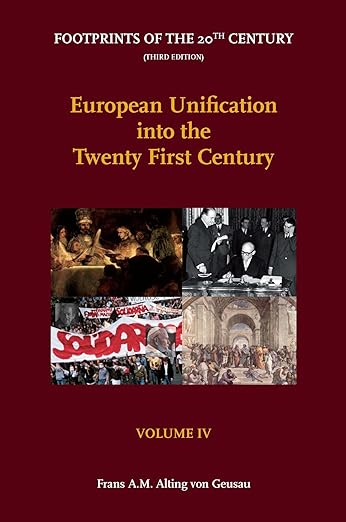
As one can read in my book European Unification into the Twenty First Century (volume IV in Footprints of the 20th Century, third edition) Europe missed its first calling in 1954, when the French National Assembly rejected the follow up the European Coal and Steel Community (ECSC) of 1951: the Treaty establishing a European Defense Community, already accepted by the other five parties, West-Germany, Italy, the Netherlands, Belgium and Luxembourg. The draft Treaty on the European Community, already ready for signature, thereafter, disappeared in the archives.
On the initiative of Belgian Foreign Minister Spaak and Dutch Foreign Minister Beyen, agreement was reached on two economic communities: the European Economic Community (EEC) and the European Atomic Energy Community (EAEC). From their entry into force in 1958, the transitional period towards a common market, 1958-1960, would be a period of crises, mainly due to the French resistance against supranationalism. A compromise was reached in the Hague Summit of 1960. It included completion of the common market, intergovernmental political cooperation and enlargement with Great Britain. European unification developed towards the internal market and monetary integration into a European Union, with the 1991 European Union Treaty, no more. It missed the call of the fathers of Europe.
Europe missed its second calling after 1989 called “The Year of Truth”. That year saw the unique result of peaceful resistance against Soviet totalitarian repression. Beginning in Poland,Czechoslovakia (Vaclav Havel) the East and Central European satellite countries liberated themselves peacefully from Soviet rule. It made an end to the Cold War, and European postwar division as agreed upon in 1945 in Yalta between President Roosevelt (USA), Soviet leader Yosef Stalin and British Prime Minister Winston Churchill.
Peaceful dissidence from Communist rule since the 1970’s developed in Czechoslovakia and Poland and found their Christian inspiration in Pope John-Paul II since his pilgrimage to Poland in June 1979. The first free trade union Solidarnosc came into being a year later, in the shipyard of Gdansk. Lech Walesa the founder later said that before the Pope’s pilgrimage he had some 20 followers in resistance, thereafter 10 million. The trade union, of course, was outlawed and a state of war imposed by the communist government. In vain, as the change of Soviet leadership showed in 1985. The election of the first non-communist government in September 1989 in Poland and its acceptance by Soviet leader Gorbachev showed that the days of all Soviet-made leaders in East and Central Europe were counted. On the new leaders request, the East and Central European countries joined the European Union and NATO, as did the three Baltic Republics Estonia, Latvia and Lithuania after their liberation in 1990.
It was in Europe’s response to this enlargement that the European Union missed its second calling. Enlargement turned out to be enforced acceptance of the economic rules and weak political cohesion of the European Union. Except for some private initiatives, the true problems of moral recovery, restoring democracy and the Christian message on unity and reconciliation were not dealt with. Contrary to Schuman and de Gasperi, the politicians of the European Union failed to build the enlargement on the Christian values of equality, the dignity of work, the primacy of inner values and fraternal charity; the dignity of the human person and their personal responsibility, respect for law, love and beauty and a commitment to truth and justice. The enlarged European Union therefore is insufficiently united to deal with the threats of an aggressive Russia and an unreliable America.
Back

- Cultural Diplomacy: Waging war by other means?

- The Illusions of Détente,
- Western Cooperation
- Sporen van de Twintigste Eeuw
- European Unification into the twenty first Century...
- De geest van Christus leeft in Europa
- Neither Justice nor Order
Footprints of the 20th Century
Footprints of the 20th Century - Third EditionDescription
The peaceful collapse of the Soviet totalitarian, communist system has been a watershed of historic proportions in Europe and the world. In 1989, unexpectedly, Communism and the Cold War were behind us, they were bad and should be forgotten. The immediate post-1989 world presented itself as a new era of organised forgetting, as neither East nor West were interested in examining the prolonged period of acquiescence in absurdities.